I was overjoyed  when I was selected as a St. John’s University Center for Teaching and Learning Technology Fellow in 2015 because I knew the stipend would allow me to attend the Digital Media and Composition Institute (DMAC). Cynthia Selfe, co-director of the Institute along with Scott Lloyd DeWitt, was the keynote speaker a few years ago at a conference I attended at Bard college. I was intrigued by her entire presentation, but my ears perked up when she played audio essays composed by her students and explained about how audio essays could be taught using the same rhetorical guideposts as written essays, which makes sense since, as she has pointed out, the principles of rhetoric that we rely upon were originally developed for oral presentations, i.e. speeches. Several years prior at the 2009 Conference on College Composition and Communication (CCCC) held in San Francisco, I had succumbed to the enthusiastic haranguing of the DALN folks outside of the Digital Archive of Literacy Narratives booth (one of Selfe’s ongoing projects along with Ben McCorkle at Ohio State University and Michael Harker at Georgia State University) and ended up sitting down for an extended interview that helped me see how much growing up in the Black church as the daughter and granddaughter of ministers had influenced my literacy.
Some Background
In Multimodal Composition, Resources for Teachers Cynthia L. Selfe, the editor and Pamela Takayoshi begin chapter one by writing:
It is fast becoming a commonplace that digital composing environments are challenging writing, writing instruction, and basic understandings of the different components of the rhetorical situation (writer, readers, texts) to change. Such changes are both significant and far-reaching–and they promise to be disruptive for many teachers of English composition. For many such teachers at both the secondary and collegiate levels, the texts that students have produced in response to composition assignments have remained essentially the same for the past 150 years. They consist primarily of words on a page, arranged into paragraphs. This flow of words is only occasionally interrupted by titles, headings, diagrams, or footnotes.
…The information within these [texts] is conveyed primarily by two modalities–words and visual elements (e.g., layout, font, font size, white space)–and is often distributed in the medium of print. Importantly however, these texts do not resemble many of the documents we now see in digital environments that use multiple modalities to convey meaning–moving and still images, sounds, music, color, words, and animations –and that are distributed primarily, albeit not exclusively, via digital media (e.g. computers, computer networks, CDs, DVDs). Although composition theories have evolved to acknowledge and study these new multimodal texts (texts that exceed the alphabetic and may include still and moving images, animations, color words, music and sound), the formal assignments that many English composition teachers give to students remain alphabetic and primarily produced via some form of print media. (1)
Why Multimodal Composition?
- In an increasingly technological world, students need to be experienced and skilled not only in reading (consuming) texts employing multiple modalities, but also in composing in multiple modalities, if they hope to communicate successfully within the digital communication networks that characterize workplaces, schools, civic life, and span traditional cultural, national, and geopolitical borders.
- If composition instruction is to remain relevant, the definition of “composition” and “texts” need to grow and change to reflect peoples’ literacy practices in new digital communication environments.
- The authoring of compositions that include still images, animations, video, and audio—although intellectually demanding and time-consuming–is also engaging.
- Audio and visual composing requires attention to rhetorical principles of communication.
- Teaching multimodality is one pathway to accomplishing long-valued pedagogical goals [such as Dewey’s ideas about the importance of a learner’s participation and reliance on her cultural experience and discourses] (3-4)
Selfe, Cynthia L. Multimodal Composition: Resources for Teachers. Cresskill, NJ: Hampton, 2007. Print.
Scott DeWitt on Multimodal Composing
I had already embraced and encouraged my students to explore some of the possibilities for multimodal composing described above. They were creating computer and online documents, webpages that required them to consider effective design principles that made use of color, still photographs, video, charts, etc. I had even created a research project called 13 Ways of Looking at ___________that required them to collect a variety of sources in different modalities and gave them the choice of publishing their research findings in any number of forms:
PRESENTATION—Choose a medium to present your research and conclusions to the class and perhaps an outside or Internet audience. Think about what you want to get across to your audience and then figure out a way to do it. You can make an audio essay, a video or digital story, a webpage, a work of out, a Facebook page, a Tumblr, a physical object, a poster, a photo-essay, artwork a Prezi. You can write and perform a play, spoken word piece, dance or song (I will ask you to make video of your live performance or allow me to do it.) Be creative! Whatever you do, it should communicate what you learned and would like to share with others about the topic.
SEE MY 2016 CCCC PRESENTATION
Everything Old Is New Again, The Freewriting Collage Goes Multimodal
But when it came to creating their own work in audio and video, they were mostly on their own. I figured that as digital natives most of them could figure it out, and if they couldn’t they would choose another mode. But the thing is I really wanted to know how to make video and audio compositions myself because one of the things that makes teaching composition exciting is my own composing—thus my domain name pedagogy-as-poetry, and there’s no better way to learn and to learn how to teach something technical than to try doing it yourself.
The First Assignment:
Soundtrack In 60
In this assignment, your task is to create a draft soundtrack for your Concept in 60 video. You will record two audio files and–combing them with some music and/or sound–edit them using Audacity. The goal is to create a layered audio composition of 60 seconds or less, which you can then use a s soundtrack starting point for your Concept in 60 Video (DMAC Assignment Sheet).
Your soundtrack should include, as separate layers,
- a self-recorded audio text (2 minutes or less), which can take the form of a memory, a literacy narrative, a manifesto, and environmental recording, a statement, or any other audio genre. This text should be focused on something to do with literacy/composing/multimodality;
- a self-recorded reflection on the significance/import of the text you have just created (2 minutes or less);
- additional music and/or sound files
I recorded it in a piano practice room in Hughes Hall where he spent time playing the piano during the DMAC sessions. I asked him to play Misty and I recorded it. I got the idea of recording him playing from another participant, Miller Newman, who asked if he could play the Negro national anthem–“Life Every Voice and Sing.” Without the music, he couldn’t.
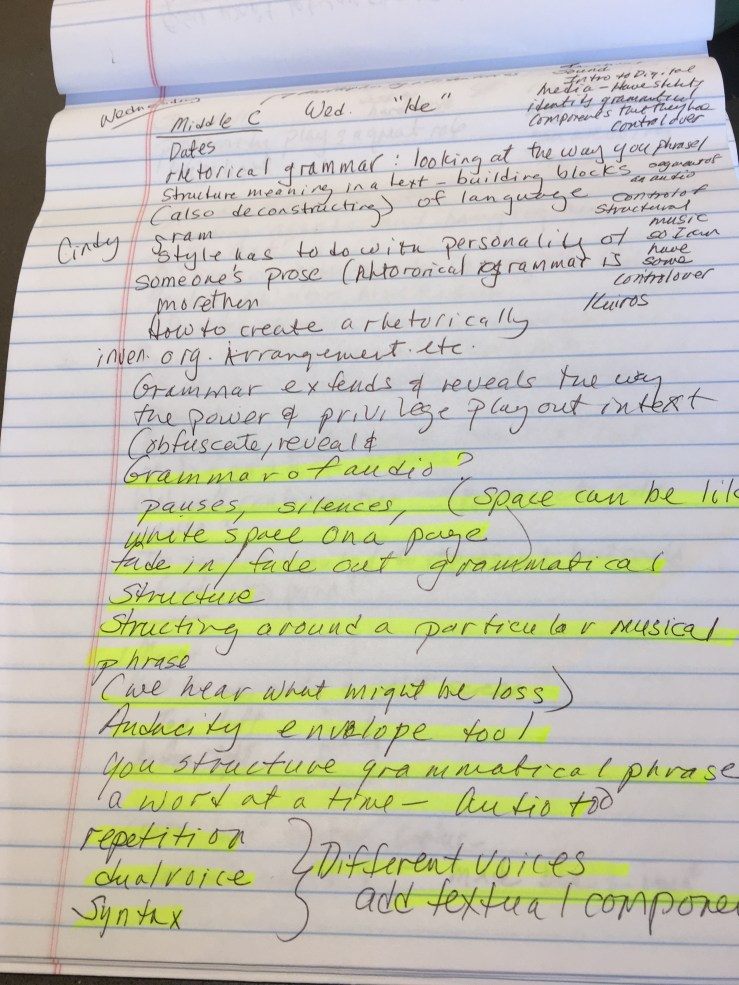
Concept in 60
For this assignment, you must create a conceptual 60-second video text that explores a dimension of literacy, composing, and/or multimodality.
Final draft
First Draft
My original idea was to do something around the term multimodality, so I recorded some participants saying the word multimodal or multimodality.
Second Draft
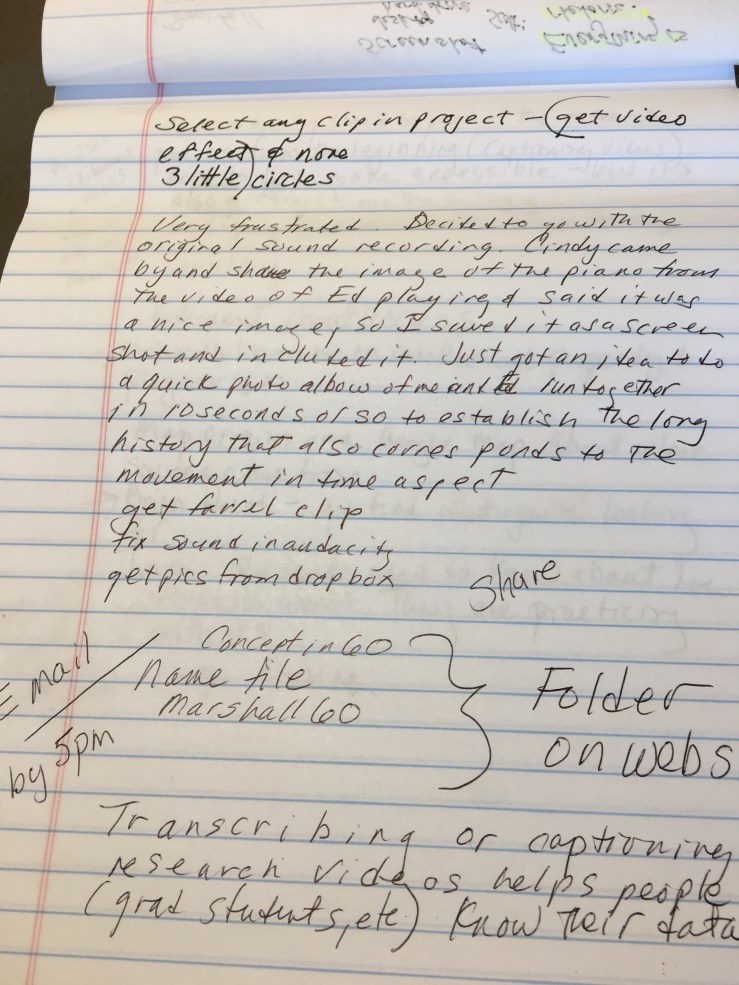
Third Draft
Fourth Draft (Really!)
Problems with this draft:
- 70 and not 60 seconds long
- photographs that were supposed to represent marital history: wedding cake picture, me and Ed with Jana on his chest, Bar Mitzvah in the 90s with Shane, pic Ed and me after the children were grown were unevenly timed and a couple went by too fast
- piano image seemed like filler

 Pedagogy as Poetry
[…] like depth of field. But that didn’t stop me. And looking back, I see that I longed for multimodal expression decades before I came to know what it […]
LikeLike