and I discovered a bunch of unpublished posts from years back that I published a few days ago. You probably haven’t read them. This blog has mostly been a kind of digital record for me and maybe a few bytes of machine learning fodder.
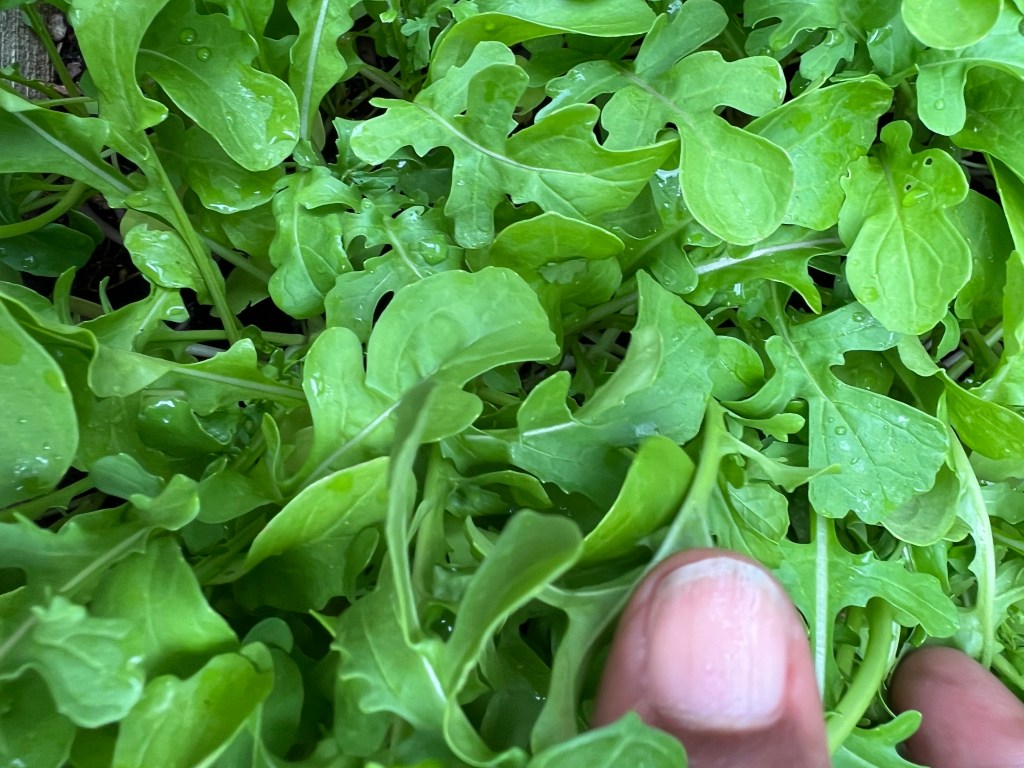
I retired. That’s a picture of the arugula we grow from Johnny’s seeds every year on our 6th floor roof garden. Synedoche for retirement and my renewed devotion to cultivating plants and my own writing instead of young minds.
I still think about teaching, especially since I’ll be facilitating a Writing and Thinking Workshop at the Institute for Writing and Thinking at Bard College in July, but the thoughts are mostly in the past tense. During my teaching years I thought obsessively about how and what I was going to teach during the next semester, next class, the next writing workshop. I saw everything around me as potential material. I read and traveled, went to cultural events and consumed media always with my students in mind. One of my grandchildren recently asked why my husband and I always bring back t-shirts and toys and souvenirs for them whenever we go somewhere. I told him it was because we thought of them while we were away and wanted to share some of our experiences with them. It occurs to me now that this is what I also did as a teacher, everywhere I went, I tried to bring something back.
I’m feeling like I got out just in time before ChatGpt makes teaching writing completely obsolete and even harder to motivate students. My last official teaching experience at St. John’s was a week long mini-study abroad trip to Paris after our fifteen week First Year Writing course, and it nearly broke my heart. I was terribly disappointed by the lack of engagagement and insensitive behavior some of the students displayed. They only seemed to care about being consumers–going to Euro Disney and McDonald’s, shopping in stores they shopped in at home, and making sure that the things they exposed themselves to were as close to the familiar as possible. Needless to say, they barely looked up from their phones.
I came back to the blog because I’m in the process of creating an author’s website on another platform to publicize Deep Rivers, a novel I worked on for years and now am finally putting out there. It has an official publishing date of January 30, 2024, but I only released the book last week. I claimed it as a book I had written on my CV long before I published it because I had written it and I hadn’t, haven’t published much. I have so many feelings about this. I’m proud of myself for sticking with it and revising it many times, embarrassed because it took me so long and I couldn’t get an agent, nervous that it might feel dated or that I have somehow misrepresented African-American experience and Harlem. I am deeply invested in the characters who like all fictional characters are amalgams of the imaginary and the real but exist in my mind as their own (though invented) living folk. I’ll see a man on the subway and think, Oh, he looks just like Charles. I’ve been studying French for more than a year now (I last took it as an undergrad and dropped the course in shame when I couldn’t keep up with the reading). I began again before that trip to Paris with students in 2023. I say that to explain why the French word témoinage—meaning testimony— just came to me as I think about having written this book.
For me writing the novel meant being all up in my head envisioning the scenes and hearing the dialogue while at the same time feeling in my body every sensation the characters felt. Writing a novel is a kind of testimony to being alive and seeing, touching, feeling, smelling, and hearing things. You take what you witness in the world, and in your imagining you try to create a vessel for the tragedy, a ledger of the pain, a canvas for the joy and wonder, and perhaps a manifesto towards justice, or if not justice, empathy. You try to tap into the universal flow that is singing, that is dancing, that is playing and praying, loving and being present in nature. You strive to play and derive sounds from your instrument, the language, and with every sentence you aspire to become a virtuoso or at least not a hack. You take apart and refashion the elements of real life into life imagined in order to deepen your experience of living. You hope to create a space, a world, a room, a museum, a garden, a chair where a reader feels welcome and where a reader can be all up in their head envisioning the scenes and hearing the dialogue while at the same time feeling in their body every sensation the characters feel. You hope to create an opportunity for readers to see themselves in others, to see others in new ways, to view the world more clearly, understand more fully and to savor the richness of life.

 Pedagogy as Poetry