It’s been nearly 5 months since I attended the DMAC institute. I have saved all the resources and bookmarked all of the links, and I taped many of the lectures using Notability, but I fear that I’ve forgotten all of the technical things we were taught. I meant to get back to my original entry about the experience and to explain the process and discuss the drafts of my concept in 6o project, but life intruded: I took students to Rome.


I spent time with my grandchildren.


I sustained a knee injury and got treatment for it. I went to a wedding in Vermont, tended my garden, worked on my novel, and read to prepare for the fall semester and my course entitled, “Writing to Make Things Right: Bias Privilege, Race and Struggles for Freedom and Justice.”


Now it’s time to apply what I went to learn because my students have begun their audio essay project. Thank you, Cindy Selfe for the student audio work you posted on your Soundcloud account, your assignments, your rubrics, your scholarship. But, of course, being the ornery (my mother might say), independent person I am, I have decided to approach the assignment my way, which is probably what you intended for us to do.
My students have been writing and sharing journal entries in response to readings, videos and prompts about empathy, privilege, bias, intersectionality, race, language practices and personal experience. I asked students to take a journal entry that they found compelling and to turn it into an audio essay—using the term essay loosely since some of the entries are narratives or poems, or to interview someone and record it based on the topics that came up in class including racial identity, immigration, language use, encounters with police, white privilege. Students listened to audio compositions on Facing Race, Storycorps, NPR and The Third Coast International Audio Festival Websites. I asked them to list the characteristics of the audio works and to respond to two prompts: “Why audio?” and “What makes a piece compelling?
Some students’ responses:
Why audio?
Audio has the unique power to force a listen to visualize the same way they would if they were reading a book, but with an added element of focus because they do not have to read at the same time.
What makes an audio essay or piece compelling?
Audio essays in particular has so much more emotion than text by itself. In the audio essays I listened to for homework, I found it interesting how powerful the silence was. Especially in the extremely emotional ones, the silence was difficult to listen to because you couldn’t tell if the speaker was just taking a pause, or getting emotional. I found myself tensing up at those pauses because I knew the story was going to become more difficult to listen to, as the speaker was having a hard time telling it. (Eve)
Characteristics of audio essays
- Individuals explaining something that is meaningful to them
- Individuals share their story
- Hear the emotions (ex: when speaker is on the brink of tears)
- Ability to hear the speaker use another tone of voice to represent an outside person
- Can hear the speaker’s voice become louder and clearer when he/she talks about something that is very important to their life and values
- Background sounds (ex: nature, music, conversations, animals)
- Laughter
Why audio?
Audio allows the listener to feel as if he/she is with the speaker. Audio is different from reading or watching something because you can hear the speaker’s emotions. The listener can more clearly tell if the speaker is being sarcastic or if a certain topic makes the speaker sad or happy. By hearing the tone of the speaker’s voice, it increases the ability for the speaker and listener to have an emotional bond. In audio, the speaker is able to say something then play something else (like music or conversations) that is related to what the speaker just said. The other voices besides the main speaker help provide live and vivid details of what the speaker is talking about. If a writer did this, it would not have the effect because the words on the paper or screen would have no sound behind it. Without sound, you don’t get a clear image of what is happening. Example: hearing a song and reading a song are two completely different things. When we hear the speaker speak, we not only get to hear it but we get to think about it at the same time. If it was not audio, we would only be able to think about it but with a less imaginative mindset.
What makes an audio essay or piece compelling?
What makes an audio essay or piece compelling is that listeners get the chance to listen. In society, people are often too lazy to read something, so if they are given a chance to hear the same words that are written, it grabs their attention. When we listen, we absorb more and are more attentive. We don’t realize it, but our voices have power. When listeners hear the voice of the speaker sharing his/her story or opinion, listeners get the chance to actually feel how the speaker feels. If we read the same words the speaker said, we wouldn’t get the same vibe because we read it in our own voice. If we read something, what stands out to us the most, might not be what is most important to the writer. By hearing it, we understand and see with our ears what the speaker wants us to grasp and what points are important. (Christie)
Students were then instructed to revise a piece from their journal that they wanted to record based on those criteria. At the next class they shared their list of criteria and their answers to the questions in small groups and before they read their drafts to each other, we came up with a set of qualities they wanted to see in the scripts.
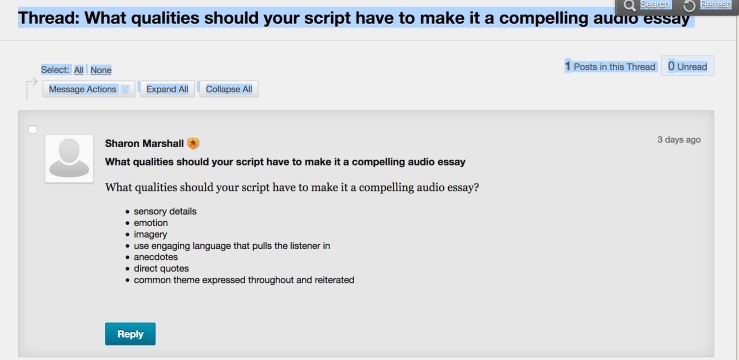
They brought four copies of their scripts to class. Originally, I was going to let them go ahead and record after they got peer feed back, but while they were working in groups of three, I read the fourth copy of some of the scripts and decided I had to intervene (read freaked out) and give my version of feedback before recording commenced.

 Pedagogy as Poetry